


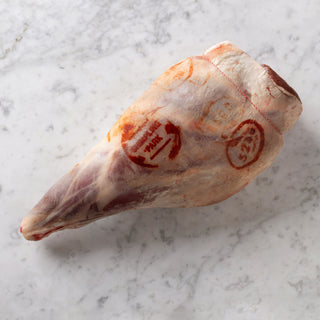

Why dry-ageing matters
Dry-hanging or dry-ageing has become a pre-requisite in the hunt for quality meat. And it's great that this is the case. In the 1960s, in the drive to save money, many retailers switched from dry-hanging to 'wet' hanging, where the meat is preserved in a sealed bag as an alternative way to tenderize: it's much quicker and doesn't require a dry-hanging room, so as a result is cheaper for the retailer. This practice still continues in many supermarkets. And it's fine, but the resulting meat simply doesn't compare to the flavour and texture of dry-hung meat.
An interesting fact: dry-hung meat freezes much better than wet-hung because wet-hung retains more water which expands when it freezes, tearing the meat as it does so and seeping out when it is cooked.
So what is dry-ageing?
Essentially, it's a carefully controlled ageing process. We see it used most commonly for beef, but it benefits pork, lamb, hogget, venison and turkey too, to varying degrees and timescales (expert knowledge required here). Meat is 'hung' from a rail in a dry-ageing room at 1–3 degrees to help it develop flavour and texture, but not so long that it spoils. And hitting this sweet spot can make or break a good bit of meat.

What makes a good hang?
There are some important considerations with hanging meat. Firstly, whole carcass hanging works better than hanging individual joints. This is because leaving the bone in protects the meat from decay and helps it age more evenly; it also minimises the surface area exposed to air, which helps reduce the need for 'trimming' and waste.
Secondly, an animal with a good fat covering and plenty of marbling can take a much longer dry-hang because the fat content prevents the meat from drying out and decaying as it ages.
Thirdly, older animals like a longer dry-hang. This is because their meat has developed more connective tissue with age, which responds better to the tenderising effects of dry-ageing.
And where do you find older animals that have had longer on pasture, with more fat and marbling? Generally in our heritage or traditional breeds. So heritage breeds and long hanging often go together, and can make the most marvellous meat.
How does dry-ageing actually work?
Hanging meat in the right conditions in a dry-hanging fridge enables two things to happen. It allows the muscles in the meat to continue to use the haemoglobin stored in its soft tissue, creating lactic acid. These acids, or enzymes, start to break down the muscle and connective tissue as they hang, which facilitates a process of tenderisation.
Furthermore, as the meat hangs, it loses between 15–25% of its excess moisture. This intensifies the flavour of the meat. And it's the main reason why some of the larger retailers won't dry-hang their meat: weight loss equals profit loss. Add to this the issue of 'trimming' – a thick, dark layer develops on the meat while it's ageing, which is a necessary layer of protection but needs to be trimmed off. The longer you hang meat, the more trimming is required, which means further weight loss from the original buying price and further profit loss for the retailer. You can see why some suppliers give it a miss.
How can you tell if beef has been well hung?
It varies with different livestock, but let's take the most commonly hung meat: beef. Signs to look out for include a dry texture on the outside. It should be very dark red in colour, almost mahogany, and a rich red colour when cut open (it should also smell deliciously 'meaty'). It should have a firm texture that yields to the touch like a cushion and hold a thumbprint when pushed in.

How long should beef be hung for?
The older the animal, the more dry-ageing it can take. Beef can take the longest hang, and the process of ageing ramps up the longer it is hung.
- 1–2 weeks: The meat begins to tenderise, but the flavour doesn't change much.
- 3 weeks: Around 10% moisture loss, which starts concentrating the flavour and begins to produce the nutty, umami undertones of a well-hung piece of beef.
- 4–6 weeks: This is where you really get some bang for your buck. Thanks to the moisture loss you'll start getting wonderfully buttery, deep flavours as the tenderisation process has properly kicked in. If you're buying a good piece of heritage breed beef from a reputable butcher, a 4–6 week hang should be just right.
- 7–9 weeks: Look out for hints of a 'blue cheese' taste (it's much better than it sounds), whilst white striations – a blend of healthy mould and salt – may form on the outside of the animal.
- 12 weeks plus: A seriously strong flavour. The meat is likely to have lost up to 35% of its original weight, which, while intensifying the taste, can also make the beef rather more expensive.
What about other animals?
Nearly all meat that we eat (other than chicken – the fresher the better) benefits from being dry-aged.
Game birds like up to 10 days at 5 degrees. Venison is good with a 1–3 week hang, depending on the age of the animal. In fact, the age of the animal at slaughter makes a huge difference to the length of hanging for all meat.
Take turkeys: a good turkey should be hung for 1–2 weeks before it is sold. But a slow-grown turkey which is older at slaughter (a Kelly Bronze, for example) can take a longer hang, which in turn helps it to develop a richer flavour and a better texture.
This is the case for lamb and pork too. Heritage, or traditional breed, pork has more marbling, more fat and is generally older at slaughter. It likes a good, long hang and as a result the flavour is much richer. The same applies to lamb. Young lambs do not need much of a hang as they are naturally tender. Hogget and mutton – often, and ideally, heritage breeds – can be hung for up to eight weeks because they have more marbling, more external fat, and have enjoyed more years wandering around the meadows, which all helps the meat stand up better to a good long hang and, as a result, better tasting meat.
Heritage breeds and dry-ageing: a symbiotic relationship
All of which seems to highlight an important fact: slow-grown, heritage breed meat works better for dry-ageing. And dry-aged meat tastes better. So if you want to eat the best meat you possibly can, it's a symbiotic relationship you shouldn't ignore.